Category: English teaching

  • A Long, Long Time Ago…

    A Long, Long Time Ago…

    Sorting through old school resources, I found this project from 1997. I was in my second year of teaching and still have memories of making this booklet as a media mini-project for Year Seven.

    The scan of the booklet shows the way in which it was constructed back in the last century: printing sections out on one of the school’s computers and then pasting it all together before photocopying the whole thing and stapling it together manually.

    I can’t recall why I chose Star Wars as the topic. I taught it before the Prequels (possibly before I’d even heard they were in production). I have a vague memory about wanting to teach epic narrative structure – but I may have made that up since. There are attainment targets drawn from the original National Curriculum and quite broad assessment objectives:

    It only got taught once. The students hated Star Wars. I hadn’t appreciated that for them it was an old fashioned film that their dads liked. They also intuitively understood that this was a pop culture that didn’t deserve the same respect as Shakespeare (or even the first Harry Potter which had just been released a few months earlier). The project was a failure and I still distinctly remember one frustrated little girl telling me over and over that she just “didn’t get it” and me getting frustrated and telling her over and over that it was a very simple story. It was a useful lesson learned by me.

  • Practical Planning for Teaching Macbeth

    Practical Planning for Teaching Macbeth

    In September I begin teaching Macbeth to two Year 11 groups. I’m starting at a new school, I’ve not met the students before and have to consider the practicalities of teaching in a post-Lockdown, Covid-safe environment. Over Lockdown and the Summer I’ve had the opportunity to read and reflect on my practice as an English specialist and try to refine my approaches to teaching. I’m recording my thoughts on preparation and deliver of Macbeth here.

    It’s about 5 years since I last taught Macbeth. While I’m aware that I’m strong at engaging students in the play and fostering their ownership of the text, I’m less confident in my skills in enabling students to respond at much higher-than-expected levels in the exam.

    I’ve worked with some teachers who are able to get good Literature grades from students. When I’ve observed them, they’ve deliberately approached delivery in an instructional, highly-didactic way. Theirs are Powerpoint-driven lessons, with lots of exam-style writing tasks which are heavily scaffolded. Students are told what to think about characters, themes, language and dramatic structure. There’s little to no personal and emotive exploration of the text. Exam-focused teaching techniques (quizzes, games, retrieval-practice activities) seem surrogates for enjoyment and fun with the actual text. Yet they get good exam results and, I’m certain, believe that getting disadvantaged children the highest GCSE grades possible is the best thing in terms of social mobility. They do “first teaching” in the way I’d expect pre-exam revision lessons to be taught. I’ve also seen them teach KS3 classes in the same way.

    Unsurprisingly, the AQA English Literature syllabus expects skills of comprehension, critical reading, linguistic evaluation and an ability to compare texts. The larger, general aims of studying English Literature are cultural (“Through literature, students have a chance to develop culturally and acquire knowledge of the best that has been thought and written”) and to encourage children to become developed readers (“encourage students to read widely for pleasure, and as a preparation for studying literature at a higher level”). Among the objectives being assessed, examiners look for an “informed personal response” (AO1) and “interpretations” (AO1).

    I’m hoping to combine an active approach to Shakespeare with exam-focused teaching that both enables students to develop a rewarding personal response to the play as well as enable them to secure better-than-expected grades. Experience tells me that engaged children are motivated to approach exams positively and gain higher grades.

    Much of what I hope to achieve comes down to careful planning.

    Initial Concerns

    In terms of planning, my initial concerns are:

    • How to genuinely engage students in the play. What can I do to ensure that students enjoy the play, find it rewarding and motivate them to approach the exam with a greater sense of ownership?
    • What is it that I want students to learn (in the broadest sense) from the play?
    • How can I balance an active approach to Shakespeare with the formal exam requirements?
    • Can I encourage an active approach in the restrictions placed on teaching and learning by Covid-19?
    • Can I teach the whole play in 21 lessons so that students are both actively engaged in the play AND really well prepared for the exam? Is there the time to encourage creative responses? I worry I don’t have time to adopt engaging and creative approaches with the mechanical teaching of how to construct exam answers.
    • What I need to do to improve my teaching so that students rapidly develop the knowledge, skills and independence to write capable exam answers? What can I bring from approaches like Rosenshine’s Principles and Doug Lemov’s Teach Like a Champion?
    • While I’m sceptical about using a knowledge organiser, what do I need to do to develop a “learning agenda” (to use Barbara Bleiman’s term) in order to support the retention of knowledge about the text? (For instance, should I create a type of knowledge organiser for each Act in which becomes the basis for retrieval practice? So, after teaching Act One, I’d give students the Act One KO and insist students used it while we read Act Two and so on.)
    • Homework and revision activities. I’m expecting students to struggle with any homework but, especially post-Lockdown, I can’t see that they can successfully study Macbeth without work at home. Any tasks I set must really be meaningful, though.

    Initial Overview

    Year 11 students have approximately 21 lessons in which to study Macbeth in Term 1. My opinion is that it’s a stretch to try and teach the text in the depth necessary – including time for retrieval practice, exam answer practice and assessment. Something like 30 lessons seems better, allowing me enough time to include lots of retrieval practice, regular reviews/recaps and time to build exam writing techniques.

    My initial plan looks something like this:

  • Why is Shakespeare the only compulsory content area in this year’s English Literature GCSE?

    Why is Shakespeare the only compulsory content area in this year’s English Literature GCSE?

    Amid the controversy over poetry being made optional in the 2021 English Literature GCSEs, there’s been little mention that the examination of a Shakespeare play is the only non-optional component. It’s possible to trace this requirement back to the 1989 Cox Report which is when the first statutory requirement for teaching Shakespeare was introduced. The question I’ve got is why is Shakespeare specifically mandatory?

    Shakespeare has a mythic status in Britain which is difficult to pin down other than a pervading agreement by all that there is something culturally worthy in his writing that schools are expected to teach. Somehow, there is a general consensus that learning about Shakespeare makes a positive (and moral) impact on individuals’ personal growth, contributes to a sense of there being a cohesive national identity and somehow enables economic prosperity.

    When was Shakespeare made so important in schools?

    Shakespeare was first named as an author in the revised Standards of Education in 1882. Sarah Olive in the excellent Shakespeare Valued (2015) says the Victorians associated Shakespeare with a “gold standard” of literacy. For Standard VI, children needed to read a passage from either one of Shakespeare’s Histories, of another standard author or from any history of England. (I find it interesting that Shakespeare is connected with English history right there from this start.) Olive goes on to say: “Shakespeare had, by the latter half of the nineteenth century, been incorporated into a curriculum of sorts and used to demarcate the highest performing students from their peers.” This placement of Shakespeare as a means of discriminating between more and less able children by the Victorians and established the value and nature of Shakespeare in state education.

    Still, why Shakespeare and not any other great poet or writer? Chaucer? Milton? Keats?

    On this train of thought, I wonder the extent of Matthew Arnold’s influence on Shakespeare’s place in the English school curriculum. In Arnold’s The Study of Poetry (1888), he repeatedly makes the case that “Chaucer is not one of the great classics…” Arnold goes on to say that what is missing from Chaucer is the Aristotlian “poetic virtue of seriousness” or “high poetic seriousness”:

    For Arnold, the greatest poets were Milton and Shakespeare. Milton is “the one artist of the highest rank in the great style” and better than Shakespeare in Arnold’s estimation. Milton has a “sure and flawless perfection of his rhythm and diction… No one else in English literature and art possesses the like disinction.” On the other hand: “Shakespeare is divinely strong, rich, and attractive. But sureness of perfect style Shakespeare himself does not possess.” Arnold’s devotion to Milton seems to me to be admiration for the strong sense of Christianity and his belief in the superiority of Greek and Latin which he sees Milton as channelling in English poetry. (In his essay on Wordsworth, Arnold writes approvingly of a comment which suggests that Shakespeare control of rhythm, musicality of language prose, style, expressing interior thought and feeling.)

    For Arnold, it was the sense of consequence which marked great literature:

    The substance of Chaucer’s poetry, his view of things and criticism of life, has largeness, freedom, shrewdness, benignity; but it has not this high seriousness. Homer’s criticism of life has it, Dante’s has it, Shakespeare’s has it.

    The Newbolt Report (1922) – which essentially established English as a school subject in a form that’s recognisable to today – agreed that Shakespeare was necessary but recommended that Shakespeare was taught as extension to all pupils. This echoes what George Sampson had urged in English for the English:

    “Shakespeare is not only difficult but archaic as well; and thus he seems doubly unsuitable for young readers. Fortunately, he is saved for the schools by his wonderful power of re-telling a story in dramatic form and his equally wonderful power of characterisation, and we may add, his incomparable mastery of word-music. Indeed, it is Shakespeare the musician as much as Shakespeare the dramatist to whom we must introduce our pupils.”

    In A Language for Life (1975), the Bulloch Report barely mentioned Shakespeare (once plus a mention in a dissenting note by Black Papers contributor and headteacher Stuart Froome). Bulloch discusses the value of teaching Literature as bringing children:

    into an encounter with language in its most complex and varied forms. Through these complexities are presented the thoughts, experiences, and feelings of people who exist outside and beyond the reader’s daily awareness. This process of bringing them within that circle of consciousness is where the greatest value of literature lies. It provides imaginative insight into what another person is feeling; it allows the contemplation of possible human experiences which the reader himself has not met.

    The Kingman Report of the Committee of Inquiry into the Teaching of English Language (1988), barely mentions Shakespeare.

    Sarah Olive in Shakespeare Valued suggests that it was the late-1980s policy-makers combined with the amount of pedagogic literature created as a consequence of the introduction of the National Curriculum and the influence of organisations like the RSC, the Shakespeare Birthplace Trust and The Globe.

    Sarah Olive in Shakespeare Valued (2015) – which is, as far as I can tell, the only major study of why Shakespeare has a central value in education (although limited to the period 1989-2009) – argues that

    The curriculum is silent about what should be achieved through the study of Shakespeare in particular. Standards to which students should aspire in their work are defined across English rather than in relation to Shakespeare: the skills, and increasing quality with which they are to be performed… Furthermore, reasons why Shakespeare might be the most fitting author to make compulsory go unwritten

    It’s an excellent, informative analysis. Early on she cites Michael Bristol’s Big-Time Shakespeare (1996) which examines how the policies of the Thatcher government commercialised Shakespeare and presents the “phenomenon” of Shakespeare as being “collectively ‘generated out of the innumerable small-time accomplishments of actors and directors, advertising copy-writers, public relations specialists, as well as scholars, editors, and educators’”.

    Olive argues that the post-1989 teaching of Shakespeare has been affected by “broader agendas for raising skills, standards and social inclusion” by both Conservative and Labour governments and that they remain united in their attitude that Shakespeare contributes to economic, moral and social growth. She identified Professor Cox, who had been taught by Leavis at Cambridge as responsible for the literary recommendations established in the National Curriculum. She presents him as Arnoldian in his belief that great literature has a humanistic value. Olive claims that Thatcher was not interested in the details other than having a preoccupation with language and “skills”.

    Cox gave far more emphasis to Shakespeare in English than ever before for Ages 5 to 16 (1989):

    Many teachers believe that Shakespeare’s work conveys universal values, and that his language expresses rich and subtle meanings beyond that of any other English writer. Other teachers point out that evaluations of Shakespeare have varied from one historical period to the next, and they argue that pupils should be encouraged to think critically about his status in the canon. But almost everyone agrees that his work should be represented in a National Curriculum. Shakespeare’s plays are so rich that in every age they can produce fresh meanings and even those who deny his universality agree on his cultural importance.

    As far as I’m aware, this is the only official explanation why Shakespeare has the importance in the curriculum that he has today.

    Cox also emphasised an active approach to teaching Shakespeare and other literature:

    Pupils exposed to this type of participatory, exploratory approach to literature can acquire a firm foundation to proceed to more formal literary responses should they subsequently choose to do so.

    Cox didn’t seem to have the same imperative to study Shakespeare in dry, academic fashion we see today and, instead, gave teachers much more professional agency in the manner in which Shakespeare was taught:

    every pupil should be given at least some experience of the plays or poetry of Shakespeare. Whether this is through the study, viewing or performance of whole plays or of selected poems or scenes should be entirely at the discretion of the teacher.

    He also insisted that Shakespeare should be taught as drama:

    pupils should approach plays through the dramatic medium. This exploratory and performance-based approach will not only lead to a deeper understanding of the text in question (a dramatic exploration of a speech in Shakespeare, for instance, will show how the placing of different emphases can alter fundamentally one’s interpretation of character or meaning) but will also lead to an understanding of the play as theatre. Performance-based activity may, of course, take place at classroom level, in small-scale improvisational sessions or in text work. Where practical, however, pupils should be encouraged to take every opportunity to widen their experience of audiences and/or co-actors. The mounting of school productions and active involvement in community or touring theatre initiatives are thus of immense value.

    The Warwick Evaluation noted that teachers felt that the National Curriculum had altered their teaching of Literature by increasing the amount of literature-based activities and ensuring the SAT requirements were met. This included teaching plays by Shakespeare. Teaching the required Shakespeare play in Year 9 was related as taking up a great deal of time (and caused them to abandon schemes of work in order to prepare children for assessments – I remember this well!).

    The 2004 revised NC prescribed: “two plays by Shakespeare, one of which should be studied in key stage 3”. In the early 2000s, the newly-founded AQA English GCSE syllabus included Shakespeare as a coursework “crossover” piece whose “task should enable candidates to demonstrate their understanding of, and engagement with, at least one play by Shakespeare studied during Key Stage 4… it must allow the candidate to demonstrate awareness of social and historical influences, cultural contexts and literary traditions which shaped Shakespeare’s writing and/or which have influenced subsequent interpretations of his work.” The form or genre was not prescribed and enabled students to respond to characters, specific scenes or specific performances. Unthinkably – from today’s standpoint – students could present their knowledge and understanding orally. It was made clear that any answer needed to show “sufficient evidence of textual knowledge”.

    Some attempts were made in 2008 to encourage a more active and considered approach to Shakespeare in 2008’s Shakespeare for All Ages and Stages but this remained vague about why. I’ve written about it here.

    More recently, things have largely shifted towards the approaches to teaching Shakespeare focus purely on securing exam results. Practices which would have been condemned as encouraging “unsympathetic attitudes to literature” (see below) for nearly a century of English teaching are currently all the rage.

    Am I surprised that no one has even asked why Shakespeare is considered the only compulsory element of next year’s GCSE English Literature? No, not really.

    Shakespeare in Exams

    My understanding is that Shakespeare has been used as a mechanism of assessment in secondary schools since the Second World War. The type of questions in this paper remain similar for the next fifty years: a number of short-answer questions about details of plot and character followed by a longer question requiring the candidate to respond to the whole text. This 1957 exam paper shows the sort of responses expected of candidates for O-level.

    Up until the 1970s children would either paraphrase passages or identified characters and aspects of plot. This approach was replaced by passages for close analysis based on a detailed knowledge of the play (I would imagine this was a response to the impact of the followers of Leavis like David Holbrook and Peter Abbs). This far more analytical approach was made “open book” so children had access to a text in order to show critical appreciation.

    Changes in the 1970s seem to be a focus on the requirement to “refer to words” in longer answers. In a 1974 London exam board O-level paper, the longer Macbeth questions were:

    ‘Security is mortals’ chiefest enemy’ Write a short paragraph explaining what this line means. Then show in what ways the truth of this statement is illustrated, by referring to the words and behaviour of both Macbeth and Duncan.

    Trace the stages by which Lady Macbeth becomes gradually less dominant during the course of the play, making clear your changing feelings towards her as the play progresses.

    In the 1980s, O-level Shakespeare seem to have been a similar mixture of short answer questions about specific details from a play (eg. “What two things has Caliban told Stephane to do in order to destroy Prospero (line 30)?”) and longer answer whole-text responses, for example on Macbeth:

    Re-read the last part of Act 1 scene 3 from the point where the witches disappear (line 79) to the end of the scene. Write about the different ways in which Macbeth and Banquo react in this scene. How does the relationship between them develop as the play continues?

    1984 English Literature O-level, Cambridge Examinations

    In the report on the 1984 English Lit O-level, the examiners insist that:

    “The question of direction is a fundamental cause of concern. The vigour and thrust of this paper stems from an intention which should be present in the teaching and at all stages of approach to literature: to enable people to read with perception, thought and sensitivity but without predetermined directions. In setting questions we still have a good deal to learn about how to open questions freely without implying directions to candidates about ‘approved’ ways of thinking.”

    (As an aside it is incredibly frustrating to compare the way that the report disparages the “unsympathetic attitudes to literature” developed in the manner in which children were prepared for CSEs and O-levels. These are the self-same approaches currently lauded in our exam-fixated English classrooms.)

    What Shakespeare has and is actually taught?

    Based on looking at which plays were taught for exam, it looks like following World War 2, Richard II and The Merchant of Venice were chiefly set. (It’s worth pointing out that children were also required to read Chaucer – another indication that Shakespeare did not have supreme importance in the Literature curriculum). In the 1970s tastes changed to Macbeth and Twelfth Night. In the 1980s, The Tempest and A Midsummer Night’s Dream appear to be the favoured texts.

    In a recent issue of English in Education, Victoria Elliott and Sarah Olive surveyed teachers and discovered that Macbeth, Romeo and Juliet and A Midsummer Night’s Dream were the most taught plays up to GCSE. In sixth form the choice of plays were:

  • Shakespeare for All Ages and Stages

    Shakespeare for All Ages and Stages

    In 2008 – during the era of the various National Strategies – the Department for Children, Schools and Families in collaboration with organisations like the QCA and RSC produced Shakespeare for All Ages and Stages, not only a booklet giving guidance on the teaching of Shakespeare in schools but what it variously describes as a “framework of opportunities” or even a “map of opportunities”.

    Don’t groan when you see the pun in the title, though. It seems to have been unintentional.

    It’s noticeable that it begins by asking the question “Why Shakespeare?” and immediately finds difficulty in articulating why Shakespeare is so essential for teaching in schools. Instead of celebrating Shakespeare’s humanism or literary qualities, the booklet places Shakespeare’s economic value and world-standing as of primary importance:

    His work is at the centre of Britain’s twenty-first century theatre industry, is constantly adapted for film, has been translated into hundreds of languages and is performed throughout the world today.

    Shakespeare’s other purpose is in enabling social and political considerations:

    Watching, performing and reading the work of this extraordinary poet and playwright asks us both to challenge and celebrate our social and personal lives. Shakespeare can open up brave new worlds to young people and offer them fresh ways of dealing with familiar ones. His work can challenge our language skills and introduce us to new realms of poetic playfulness. He can extend our concepts of what fiction can do, and of what stories a drama can tell. Working with Shakespeare can be challenging but is eminently rewarding, rich and fulfilling.

    Why Shakespeare, though? Why Shakespeare is elevated to importance above other writers isn’t addressed. Why not Chaucer? Milton? Keats? Is it because Shakespeare wrote more surviving plays than his contemporaries? (Shakespeare does seem to win by the numbers: Shakespeare: 40, Middleton: 30+, Jonson: 20+, Marlowe: 17, Fletcher: 16+, Webster: 9). The “Why Shakespeare?” question isn’t answered at all. Instead we’re to be dazzled into teaching Shakespeare by his reputation and “relevance”.

    The booklet gives a “framework of opportunities” in which “significant experiences” are recommended. Perhaps this booklet was aimed more at primary teachers as many of the “significant experiences” it suggests would be fairly routine in secondary schools: studying the plays, watch a production, use dramatic approaches to explore the plays.

    Bearing in mind this was produced during the great era of objectives of the National Strategies, the “opportunities” are transformed into year on year objectives:

    After that there are “Suggested Teaching Approaches from the Foundation Stage to Key Stage 4” which are linked to strands of the primary and secondary Literacy Frameworks.

    Many of the teaching approaches are based on encouraging younger children to consider texts in terms of literary heritage. For instance, Year Seven students should be taught “To engage with some of the issues, themes and ideas in Shakespeare’s plays and to appreciate the way they remain relevant in the 21st century”. It suggests that Year Eight students should be taught “To understand how characters’ actions reflect the social, historical and cultural contexts of Shakespeare’s time”. Another is “To understand the cultural significance of Shakespeare and his place in our literary heritage”.

    In Years Nine and Ten there’s a focus on characters, dramatic conventions and language but, in Year Eleven we’re back with the “relevance” of Shakespeare. The objectives for Year Eleven are “To understand the significance of the social, historical and cultural contexts of a Shakespeare play” and “To appreciate the moral and philosophical significance of Shakespeare’s plays and their relevance for a contemporary audience”.

    There are interesting ideas in the booklet for English teachers to use – particularly active approaches – that encourage students to consider the play as a drama (for example, sculpting a scene or creating models of stages). Bearing in mind I’ve just read a book where practical learning tasks are disparaged in favour of “knowledge instruction”, lots of the ideas are quite refreshing and a reminder that the philistine and rote-driven teaching which dominates English lessons at the moment doesn’t need to be this way.

    Shakespeare for All Ages and Stages can be downloaded here.

    Macbeth

    There are some teaching suggestions for Macbeth provided in the booklet:

    • “Hot-seating a character at a moment of dilemma, for example, Macbeth after the murder of Duncan. The teacher might be hot- seated by pupils first in order to model the process before moving on to thought tracking whereby pupils can be taken from ‘public answers’ to more private responses in order to reveal the differences between what a character says and what they might really think.” (Year 3)
    • “Giving pupils the opening scene of Macbeth, perhaps on the whiteboard, and practise chanting the lines together with them. Show pupils images or extracts from one or two productions to see how the witches have been portrayed. Ask them how they would portray the witches and ask them to act out the scene in groups of three. Compare the different presentations, and encourage each group to explain why they presented their witches in a particular way.” (Year 3)
    • “Taking a play with a strong theme, e.g. ambition in Macbeth and helping pupils to explore it through a familiar scenario, e.g. “Have you ever been temped to do something that you knew was wrong because you wanted something very badly?” Ask pupils to explore this through discussion or role play before exploring it in the context of the play.” (Year 6)
    • There’s a description of a cross-phase project at Larkmead School based on Macbeth which involved simple drama work, storyboards and use of software (Kar2ouche) for children to animate scenes.
    • “Taking a significant scene from a play and exploring its various interpretations in two or three different film versions. Possible film versions include Macbeth (Polanski’s 1971 version and the RSC’s 1979 version starring Ian McKellen and Judi Dench)… Explore the effect and impact on the viewer created by each interpretation by considering the decisions made by the director with regard to setting, costumes and how actors play their parts.” (Year 7)
    • “…focus on modern parallels to some of Shakespeare’s key themes, for example, by: …How far would I be prepared to go to get something I really want? (Macbeth)” (Year 7)
    • “Exploring the very real belief in witches and their malign influence as portrayed in Macbeth (James 1 had taken part in the interrogation of witches and believed that they had attempted to drown him on a sea voyage). Ask pupils to contrast the reactions of Macbeth and Banquo to the witches in Act 1 Scene 3 or explore Lady Macbeth’s reaction to her husband’s letter in Act 1, Scene 5.” (Year 8)
    • “Placing the name of a key character on the wall or screen and annotating it with quotations which focus on his or her feelings and state of mind at key points in the play. This activity is best applied to a character who undergoes change or development from the beginning to the end of the play: Prospero from The Tempest is a good example as are Macbeth and King Lear.” (Year 9)
    • “Exploring some of Shakespeare’s villains, such as Iago, Macbeth, Richard III, Don Pedro, Claudius, etc. As a starting point, take a character from the current play who might be considered a villain and place him or her on a continuum with other Shakespearian villains, from those whose evil seems inexplicable to those who are more complex, flawed characters to those who are likeable rogues. Tease out the nature of the villainy in the character in the core play. Notions of leadership, heroines, outsiders etc could be similarly explored.” (Year 10)
    • “Putting a character on trial, involving every member of the class in various ways, e.g. as a character witness, as an expert witness, as a victim of the defendant, etc. Invite pupils to make creative links with other plays, e.g. by transposing the doctor in Macbeth to stand as an expert witness for Othello or Hamlet. This might form part of a piece of speaking and listening coursework as well as a response to Shakespeare.” (Year 10)
    • “Investigating Shakespeare’s treatment of his source material and the way he adapted it for dramatic and artistic reasons, e.g. Richard III was a successful soldier and popular leader, a patron of the Arts; Macbeth was actually a good king who reigned in Scotland for many years. Pupils might write in role as Richard’s or Macbeth’s lawyers, demanding a retraction of the damaging portrayal of their clients.” (Year 11)
    • “Using whole class and group discussions and strategies such as ‘conscience corridor’, ‘walk of fame’ and ‘walk of shame’, encourage pupils to explore the moral issues that underpin the play they are studying. Build up a working wall display on these issues and allow pupils to annotate the display with quotations or their thoughts on characters’ actions that exemplify these themes. Encourage them to make connections with films, novels, and popular TV series, e.g. the parallels with the downfall of Macbeth and Darth Vader in their pursuit of power. Pupils could write the obituary for their chosen character using evidence from the play to demonstrate how their actions, their attitudes and what other characters have said and feel about them, reveal their moral position and how it is contrary to the good of society.” (Year 11)
    • “Asking pupils to identify the characters that represent moral or philosophical perspectives or could be seen as a moral touchstone for the themes of the play, e.g. Banquo and Macduff in Macbeth, Polonius in Hamlet or Cordelia in King Lear. Pupils might plan and present a 15-minute version of This is your Life using other pupils as characters who talk about the star of the show and their exemplary life.” (Year 11)

  • Preaching to the Converted: on reading Margaret Mathieson’s Preachers of Culture

    Preaching to the Converted: on reading Margaret Mathieson’s Preachers of Culture

    Partly out of a sense that I don’t know enough about the origins and history of my subject and a desire to clarify what it is I believe an English teacher should be, I’ve just finished a detailed reading of Margaret Mathieson’s Preachers of Culture.

    Preachers of Culture: A Study of English and Its Teachers, published in 1975, charts the development of English as a school subject and the construction of its “diffuse” ideology. It’s a fascinating read and provides a valuable account of the differing attitudes towards English as a subject. Mathieson explains the origins of English from basic literacy, the adoption of literature as a subject by the Mechanics’ Institutes and London University, Matthew Arnold’s influence, the influence of classical education, the Newbolt report, progressive influences, F.R. Leavis and the Cambridge School of English, M.A.K. Halliday and post-War linguistics up to the radical theories of the 1970s.

    Preachers of Culture shows how each redefinition of English has responded to changing social conditions and attitudes, primarily the First and Second World Wars but also urban development, the growth of schooling and technological changes.

    Mathieson contends that the foundations of English were based on the nineteenth century educational debate between classicists and scientific study combined with the influences of Victorian liberals including Matthew Arnold. Concerns that Britain was falling behind educationally drove The 1921 Newbolt Report which – for all intents and purposes – established English in an early form recognisably similar to what is taught today.

    A fear of cultural decline and the pernicious influence of capitalism caused English to develop with a distaste of modern society and mass media. Initially, English teachers were urged to be missionaries who would evangelise culture through literature to working class children. Mathieson argues that a burden of responsibility was placed on English teachers through charging them with the task of using literature to (morally) make working class children better people. Progressive thinkers introduced creativity (through writing, drama, mime and dance) as an extension to this.

    F.R. Leavis and his followers (in the 1960s David Holbrook and Fred Inglis) had an enormous influence on English teaching in universities and schools. The scholars of the Cambridge School called for “warriors” who would “resist” the developing cultural disintegration (the encroachment of cinema and the popular press on the quality of life) and sought to challenge the “false” emotions engendered by cinema and popular fiction with the great works of literature. Through teaching children to be better critical readers they believed they were sharpening children to be better people and – in I.A. Richards’ view the “fine ordering of responses” engendered a “fine conduct of life. In responding to literature, children needed to use both intellect and emotions. The militaristic terms in which Leavis and his followers spoke conveys their sense of urgency. So, too, does it convey the additional onus on English teachers of “saving” the lives of working class children.

    After the Second World War, a developing social interest in the values transmitted through English saw the introduction of different methodologies into English: most importantly the role of speech in the classroom (both in the sense of an awareness of the value of working class speech) as well as discussion. Linguistics sought to reduce the influence of Literature in order to educate working class children in using language more effectively as well as value their own speech. Radical English teachers of the 1970s sought to use the subject to explore issues and challenging existing systems of authority so that English teachers became collaborators.

    I’m beginning to realise the impact Leavis had on me when I read him at university. My approach to English teaching has indeed been “diffuse” and, over the years, shifted between progressive ideas about creativity and a vague notions of the value of English (literature) on people. I’ve generally held the view that books enable children to think and feel like other people in a way that almost no other medium can provide (I’m tempted to argue that video games can do this – but that needs more thought on my account). Books – especially poetry – develop different modes of thinking that I have always believed develop people emotionally and intellectually. Like Leavis and Richards, I’ve always seen no separation between “Life” and “Art”. Perhaps this is the influence of my schooling in the 1970s and 1980s where I was undoubtedly taught by English teachers who were influenced by books like English for Maturity and taught me to come to text personally and emotionally. My appreciation of the crucial importance of Literature has always been intuitive. When I trained as an English teacher in the mid-1990s, trainees were being urged to think of ourselves as “facilitators” rather than providing instruction. I’ve retained an element of that in the way I teach English. This might account for the sense of shock I’ve felt in the way English has been corralled into aping classical studies since 2010 and the regret I’ve felt at the pragmatic way I’ve responded.

    What have I taken away from reading Preachers of Culture? I’ve got a much firmer grasp of how English ended up as the “diffuse” subject it actually is. I can see the strands of influence from Arnold onwards and I have a much clearer understanding of why certain aspects of English practice are conducted. Above all, Preachers of Culture (along with other books about teaching I’ve read recently) have revivified – to use a Leavisite term – my sense of the values and importance of being an English teacher.

    My notes on Preachers of Culture are here:

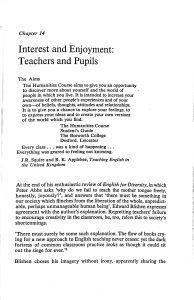
  • Interest and Enjoyment: Teachers and Pupils

    Interest and Enjoyment: Teachers and Pupils

    Notes from The Preachers of Culture by Margaret Mathieson (1975)

    Chapter 14 – Interest and Enjoyment: Teachers and Pupils

    The final chapter of the book considers the role of pupil engagement and classroom relationships in contemporary (1975) approaches to English teaching (particularly in areas of creative writing, use of media and oral discussion).

    • Peter AbbsEnglish for Diversity – asks why English fails to be taught “freely, honestly, joyously”?
    • Quotes Edward Blishen (1971): “There must surely be some such explanation. The flow of books cry­ing for a new approach to English teaching never ceases: yet the dark fortress of common classroom practice looks as though it could sit out the siege for ever.
    • Mathieson suggests that many teachers’ resistance to new approaches should “be considered in the light of the profession’s history and status, and the inevitable strain and uneasiness associated with their role. Conditions in many schools, moreover, in terms of large classes, insufficient time and shortage of specialists, remain unhelpful to teachers in their efforts to disseminate culture, stimulate creativity or promote greater social justice by means of pupil participation. Above all, English teachers may be discouraged from adopting the recommended new approaches by the possibility of conflict with pupils’ parents, their fellow staff and headmasters, some of whom may misunderstand the contemporary shift of emphasis from knowledge and formality to feeling and freedom.
    • An increased “heavy stress” on prescriptive writing has made the organisation of lessons more complicated. Plus likely to have produced uncertainties about how much learning has been achieved.
    • Romantic progressivism (with its valuation of children’s creativity and suspicion of teacher instruction) has reduced academic content of English. This influence has been accelerated by radical influence in education and an insistence on the radical influence with an insistence on the cultural validity of previously neglected groups in society.
    • Nell KeddieTinker, Tailor – “school education is historically and technologically stagnant… the insistence upon literacy is peculiar to education and not to the life worlds of the learners … in most other contexts of their lives”.
    • In America cultural relativism centres on schools’ acceptance or rejection of working-class (black) culture.
    • Mathieson argues that because certainties about what has been achieved have been diminished, successful lessons are considered in terms of enjoyment and interest. She suggests that these lessons offer classroom experiences of “dubious quality”.
    • In terms of Literature the high value placed on feeling and experience has meant English teachers have had to come to terms with Leavisite/progressive/radical hostility to examinations. Mathieson: “Thus, until such time as examina­tions are designed to measure reliably qualities like appreciation, sensitivity and sincerity of personal response, the literature teacher remains in a dilemma as far as his approach to the texts is concerned.
    • Examinations confer respectability on school subjects.
    • Often regretted that exams test pupils knowledge rather than their capacity to experience literature. Mathieson: “The English teacher omits preparation for examinations at his peril; pupils will either not ‘know’ the work sufficiently well to achieve success, or, against the context of an examined curriculum, will fail to take litera­ture seriously.
    • Mathieson suggests that only the most exceptional teacher can stimulate sustained interest in English work.
    • Mathieson argues that conscientious English teachers “lead double lives”: working away from “coarse testing processes” but must prepare children for exams.
    • Without exams, teachers do not have the security of set books and have responsibility of choosing texts. Mathieson: “If they reject teaching knowledge about literature, which is generally agreed to be mechanical, ‘academic’ and dull, they have to work out ways of making each text personally meaningful to all their pupils. Success here appears to be elusive.
    • Analysis of usual teachers approaches show it is difficult for them to be both “personally exploratory and effective”.
    • Douglas Barnes comments on English teachers’ heavy dependence on factual questions. The ability to probe, to draw children out appears to be rare in teachers.
    • Opponents of exams fail to recognise that exam support average teachers who find it difficult to generate classroom excitement.
    • Creative work. Mathieson: “The central problem arising from creative work in the classroom has already been discussed in Chapter 13. Teachers must define their views about the kind of stimuli they employ, about the role of high culture in this work with working-class children, as well as gauging its value in their pupils lives, and their degree of responsibility for finding time for technical writing. On a day-to-day level, they face problems of evaluation and planning. Each teacher, if he is to move beyond grateful acceptance of anything which his pupils produce, has to work out what he means by ‘imaginative growth’, and how to encourage what he perceives as progress or improvement. With each class or, ideally in the view of some eductors, with each pupil, he has to follow a course somewhere between lesson-by-lesson stimuli and the mechanical’ superimposition of a syllabus.
    • Fred Inglis and David Holbrook urge English teachers to stand against commercial entertainment but others recommend the inclusion of media-based lessons. Mathieson discusses the difficulties with this (including being an “outsider” to adolescent culture).
    • Schools Council Report said that English teachers needed to include media in order not to alienate children though it suggested that working-class children saw it as time-wasting.
    • Current (1975) popularity of classroom discussion – particularly of controversial topics. The Newsom Report is very enthusiastic about discussion (calling this “mutual exploration”). The purpose if to “trustfully roam” in conversation. Mathieson suggest that discussion of any quality might be very difficult for teachers to achieve.
    • Musgrove and TaylorSociety and the Teacher’s Role (1969) – research into children’s perceptions of a teacher’s role shows that they “expect to be taught, to have mysteries explained” and that “most weight to the good teacher’s teaching, least weight to his personal qualities”.
    • Denis Lawton suggests that offering classroom discussion will bewilder and alienate working class pupils.
    • Douglas Barnes noticed the infrequency of open-ended questions in English lessons. Or unable to extend discussion in a meaningful way. (American commentators described oral lessons as “little more than directed play” – in best British schools!).
    • Patrick CreberLost for Words – supports efforts to encourage pupil-directed discussion but admits that “he teacher’s new, less formal role is not an easy one. What he has to do is often a good deal less clear than what he is not to do”.
    • Success in oral discussion depends heavily on the teacher’s personality and intuitive grasp of the classroom situation but is not defined. Usually success is defined by the contributions of difficult, unresponsive or passive pupils.
    • Stenhouse suggests that the teacher’s personality figures greatly and that here is a neglect of consideration of how well informed the teacher needs to be.
    • Many teachers insufficiently informed enough to profitably chair discussions on complex issues. Using pupils’ opinions – often drawn from experience of the media – can diminish and trivialise the subject under discussion and leave pupils simply exchanging prejudices.
    • Nell Keddie suggests that it is higher-achieving pupils lack of questioning what they are taught that contributes to their educational achievement.
    • Mathieson: “It is surely of dubious value to these and to all other pupils to have their opinions left unchallenged or leadership of their discussions taken over by the most aggressive or confident members of their class.
    • Conclusion is that English teachers must reconsider the functions of knowledge and traditional skills of literacy. Exclusive attention to enjoyment and interest can trivialise issues, confine children to their own experience.
    • Neil Postman wants teaching to be a “subversive activity” and teachers to be “crap detectors”.
    • Neil Postman and Nell Keddie both express reservations about teaching reading but Mathieson argues that without literacy it is difficult to believe that pupils’ critic faculties can be developed.
    • Part of Postman‘s arguement seems to be that pupils can use new technologies (at that time 8mm cameras and tape recorders).
    • Anthologies like Penguin’s The Receiving End. They bring the outside world into the school, are “relevant” to children’s lives and are dramatic in their appeal.
    • Mathieson briefly recounts the trends/influences in English teaching and concludes the book with: “Today, advised to renounce their knowledge and control, they are asked by the radicals—as are all teachers—to stop being teachers altogether, to be, simply, people who help other people.
  • The English Teacher’s Role: Strain and Conflict

    The English Teacher’s Role: Strain and Conflict

    Notes from The Preachers of Culture by Margaret Mathieson (1975)

    Chapter 13 – The English Teacher’s Role: Strain and Conflict

    In this chapter English is presented as placing its teachers into stressful and vulnerable roles due to its diffuse nature and conflicting ideologies.

    • Mathieson: “This chapter suggests that progressive English teachers are likely to experience strains and tensions that are more severe than those felt by other members of staff.
    • Gerald GraceRole Conflict and the Teacher – “Grace’s research showed that the greatest pro­fessional confidence, that is the least role conflict, existed in those teachers whose aims were the most narrowly defined, whose role was clearly prescribed, and whose certainty of consensus of purpose with fellow staff, parents and pupils was the strongest.”
    • “Conversely, teachers in the ‘value’ subjects experienced the greatest role conflict, particularly when they were working with low-ability pupils or in situations where they ‘felt uncertainty about actual learning achievements’. This response about satisfaction within teaching illustrates something of the difference between the cognitive and the affective subjects as represented by mathematics and English.
    • Mathieson: “As it has been seen to touch upon every aspect of pupils’ lives, most particularly the emotional, English has become increasingly diffuse. Moreover, there are within it, more than most other subjects, marked political differences between the leading figures in the field. As they relate to decision-making about priorities and responsibilities in the classroom, these differences must affect many English teachers’ sense of purpose and professional confidence.
    • Widespread dissatisfaction with traditional grammar school education in last 10 years (from 1975 perspective). Progressives and radicals supporting reorganisation of schools support non-streaming, dismantling traditional subjects by rearranging them through interdisciplinary work/projects/themes and the elitism of grammars.
    • Literature has received the most severe overhauling – “every activity in English has been given a different set of emphases.
    • Others than progressives have questioned the value of academic approaches for working class pupils. G.H. Bantock and David Holbrook, concerned about exploitation by commercial culture, are concerned that a watered-down grammar school curriculum has failed to affect the lives of the great majority. They have proposed the revival of popular culture. Instead of set texts, periods of literature etc, they propose more mime, dance, poetry reading and writing. An affective education.
    • Question of which culture and for whom? Imposing an alien “middle class” cultural values on working class children.
    • Mathieson: “…many conscientious English teachers see themselves faced with strongly expressed views about their role which are based upon different interpretations of social justice. Are they perpetuating social divisions by exclusively concen­trating upon the child’s own culture, or encouraging sensitive response to environment and pride in individual identity?
    • Promotion of different “cultures” (left-wing and right-wing seem agreed?).
    • Teaching of Literature most affected by conflicting views. Followers of Leavis’ “Great Tradition”. Bantock and Holbrook attack a “watered down” curriculum for secondary modern children they insist on the value of literature. Myth, folk song lead on to poetry of Blake and Shakespeare.
    • Mathieson: “Today, Holbrook and his supporters, opposing the shift of emphasis to ‘relevant’ social or environmental studies, simply disclaim the accusation of endors­ ing middle-class values; they insist upon the universality of the literary experience which, if neglected, will mean severe imaginative depriva­tion for children continually exposed to what, they argue, are the banalities of the mass media.
    • Language in Use team argue that English should be used as a means of improving social competence and literature introduced after children have achieved linguistic confidence.
    • Halliday and Doughty want literature to have a lesser place.
    • Language in Use team tend to regard complete teaching of a text as suspiciously supportive of a traditional teacher-directed curriculum. “Controversial issues” given priority over literature. Mathieson: “Several significant trends in education are discernible here. There is the wish to give children greater opportunity to talk, thus removing importance from the text and the teacher to the pupils; ‘discussion diffuses power, or at least suggests that it might be diffused’. There is the desire to blur distinctions between subjects in order to show children how knowledge is related rather than separated, strengthened by the I radical conviction that dismantling the traditional curriculum is part of a movement to promote greater social justice.
    • Some English teachers unwilling to teach literature from convictions about the neglected richness of working class culture. Resistance to literature on the grounds it is part of the syllabus of middle-class culture.
    • Chris SearleThis New Season – about English teaching in Stepney. Literature – apart from Liverpool poets – is excluded. Instead pupils write personally about their feelings and the environment. Identifies exams/academic curriculum with status-seeking of the middle classes.
    • Mathieson: “Arguing that the curriculum of the working-class pupils should be specially chosen to suit their environment, experiences and abili­ties, they indicate their lack of interest in the question of academic achievement with its possibility of pupils’ upward social mobility. Bantock and Holbrook seek no reorgansation of the social structure, investing their hopes for greater happiness in the power of creativity and great art to bring self-awareness and fulfilment. Searle, and teachers with his views, reject the present social system, recommend­ ing that ways be found to give working-class pupils confidence and pride in their cultural identity. They do not propose to enter into work in school which makes achievement in competitive examina­tions possible, having judged this to be highly undesirable.
    • Children’s creativity is an area in which most are agreed. Differences are whether it should be Literature or children’s own experiences that should provide stimuli. Mathieson: “While Bantock, Holbrook, Inglis and those English teachers who support the ‘elitists’, recom­mend the employment of stimuli drawn exclusively from the music, painting and literature of high art, and make it clear that they view creativity partly as a way back into appreciation, a radical teacher like Searle rejects this culture completely. Unlike the elitists, many of whom wish to compensate for working-class children’s loss of traditional agricultural satisfactions through a mainly affective curriculum, Searle recommends creativity to strengthen working-class children’s confidence and pride in their own identity.
    • Quotes Peter Doughty: “The only kind of written work acceptable to many teachers at present is written work that is recognisable as one variety of the language of literature, that is, intensely autobiographic, densely metaphoric, syn­tactically highly informal, and devoted to the accurate reporting of personal response to experience. . . . From the point of view of the pupils’ needs as a whole … the limitations of this assumption are im­mediately apparent… it ignores the nature and function of technical varieties of English, that is, the workaday language of a complex in­dustrial society.
    • Exclusive concentration on personal can be socially divisive. Limiting working class children to “personal” writing prevents social mobility.
    • Mathieson: “the English teacher has a heavier responsibility when he attempts to resolve it than staff concerned with other parts of the curriculum. He has to decide whether it is more in his pupils’ interests for him to accept the existence of the present social structure and to give them help to advance within it, or for him to have rejected it, on their behalf, as stifling, competitive and ex­ploitative and to encourage them to find fulfilment within themselves and their environment. It will be appreciated that these decisions within English teaching, as they are seen as likely to affect pupils’ future working and leisure conditions, might be poignantly uncom­fortable to resolve for working-class teachers. Having achieved pro­fessional status by means of success in competitive examinations, they are likely to feel a sense of obligation to working-class pupils to equip them in a similar way. It is unlikely to be easy for them to decide, on their working-class pupils’ behalf, that personal fulfilment derives solely from their inner selves and their environment, unrelated to questions of higher social status and improved working and leisure conditions. What is certain, however, is that currently English teachers are being urged by the majority of voices in their midst to concentrate upon encouragement of their pupils’ creativity.
    • In area of critical discrimination there is a general consensus that it is highly desirable. Mathieson: “Where differences exist they are about how far into the mass media the teacher will go in order to create dissatisfaction with its worst products.
    • English teachers opposed to mass media and children as “lambs to the slaughter” or “zombies” and that they are providers of some sort of antidote.
    • Quotes a School Council Project on the Mass Media and the Secondary School: “it is in English lessons that the assumptions of curriculum culture come into head-on collision with the pupils’ experience of the pop media. English and pop offer pupils two contrasting modes of under­ standing and expressing emotional experience, the one based on linear communication and literary skills, the other on multiplicity and movement.
    • Basil Bernstein‘s work on elaborated and restricted code. English teachers enthusiastic and offered compensatory experiences . More recent (from 1975 standpoint) criticisms who argue that Bernstein over-rates “middle-class speech”.
    • W. Labov and Harold Rosen argue that in some respects working class speech is superior (middle-class speech seen as “table manners”).
    • Quotes Labov: “in many ways working-class speakers are more effective narrators, reasoners and debators than many middle-class speakers who temporise, qualify and lose their argument in a mass of irrelevant detail
    • English teachers have an important decision: to accept the difficult conditions and disguise their sense of superiority of their own language skills while leading working class children into a greater range of linguistic skills or to encourage greater informality to give working class children confidence in their own identity and culture.
    • Nell KiddieTinker Tailor – most schools assume goals of making children more like teachers rather than make teachers bicultural, more like the children they teach.
    • Sometime more elaborate speech is not used to clarify and more likely to complicate and confuse.
    • Conflict when there is a lack of consensus about goals (eg. between teachers and parents). Parental anxieties about attainment and dissatisfaction with what are commonly perceived failures of discipline.
    • Mathieson: “To a far greater degree than teachers of other subjects with a measurable and recognisable cognitive content, conscientious English staff influenced by progressive notions deliberately set out to seek expression of childrens personal experiences and opinions. Infor­mality, personal confidences, criticism of established middle-class in­stitutions, and acceptance of playground language are likely to be viewed by parents as particularly characteristic of the English teach­ ing in innovative schools.
    • In traditionally organised schools Headteachers and older staff see themselves as custodians of society’s values and are “unsympathetic towards the new radicalism” in English teaching.
    • English teachers who are most interested in oral and written expression of individual experiences are at the centre of a school’s expressive relationships with its pupils.
    • Mathieson: “The conscientious English teacher who wishes to increase his pupils’ confidence will be more ready than other staff members to ignore language normally unacceptable in school. This ‘permissive­ ness’, along with his encouragement of accounts and discussions of normally unacceptable subjects, can, therefore, bring the English teacher into conflict with his headmaster, fellow staff and, in a special sense, even with the pupils themselves.
    • Quotes Harold Rosen (1973 NATE conference): “We are concerned with fostering teaching of English in which chil­dren are encouraged to use their own language about things which concern them, as opposed to English as simply literature or a means of communication. This has led to controversy recently and will con tinue to do so in the future. I think the backlash against this kind of teaching is now beginning at grass roots level in particular areas and schools.
    • Mathieson: “The somewhat disturbing implication for English teachers seems to be that hostile reactions to their work indi­cate the extent to which they are being successful; it leads once more back to the insistence in the prescriptive writing upon the need for exceptional men and women to do the work effectively.
    • Gives account of Churchfields School where other staff were suspicious of English teachers’ informality but also irritated by the self-righteousness of their defensiveness. The English Department appeared at odds with the social and cultural values of the school. Individuals foundered because they struggled alone. Needs to be part of a team.
    • Mathieson: “It must, of course, be acknowledged that ever since the Cambridge School insisted upon its special role in affecting the quality of pupils’ lives, ‘good’ English teachers have risked conflict with authority, particularly with headmasters representing traditional values. Indeed, the militant imagery of the Leavisite prescriptive writing underlined the view the Cambridge English teachers held of themselves as doing battle with the current literary orthodoxy. Resisting the classical treatment of English, with its emphasis upon grammar and elegantly written essays, many Leavisite teachers deliberately conflicted with the academic establishment. Encouraging the personal response to literature, valuing experience above knowledge, critical of antholo­gies’ noble sentiments and refined sensibilities, teachers from the Cambridge English School appeared to threaten prevailing definitions of literary studies. Nevertheless, in spite of the School’s hostility to belles lettrism, its own elitism has fused gradually with the conserva­tism of public and grammar schools. As developments in wider society have diminished the status of the classics, schools have accommodated the Leavisite English teacher as supportive of traditional values. It seems likely that today only his literary elitism and sense of messianic purpose might antagonise his colleagues, many of whom may share their pupils’ enjoyment of popular culture. The radical English teacher, though, is much more likely to be perceived as embodying a threat within most traditionally organised schools and must, unless working in a team, be prepared to be discouraged when he is misunderstood by other members of staff. The conscientious English teacher who supports any of the current orthodoxies, most par­ ticularly those recommending pupil-directed learning, sometimes deliberately setting out to redistribute power through changed ap­proaches in the classroom, is likely to antagonise or mystify some groups with whom he comes into contact inside and outside school. Except in the few highly innovative schools, he must be prepared to be either a stranger in the staff room or hope to belong to a closely knit team, defensively united against the rest of the staff. What appears to happen (from descriptions in books and articles, accounts from rueful English teachers at conferences and students on teaching practice) is that a committed group of English staff are in running battle with a confused headmaster until the central inspirational figure of the team loses heart and leaves for another post. The highly personal nature of the subject means that any successful group of staff is bound by inward loyalties rather than supported by the school as an institution. Thus, when these weaken, little remains to support the other members of the group.
    • New entrants to teaching English often suffer “cultural shock” and result in disappointment and cynicism. Mathieson: “In this area, knowledge about social structure, the school as an institution, and the history of their profession might be more helpful during the period of training than prescriptive, activist approaches characteristic of colleges and departments of education.”
    • Quotes J.R. Squire and R.K. ApplebeeTeaching English in the United Kingdom (1969): “At its best the spirit is crusading and alive; at its worst, it is intolerant and neglectful of many literary values … too many lessons lack closure, direction, or planning… and time passed in the classroom is not easily distinguishable from time out of school.
  • Social and Academic Background of Teachers

    Social and Academic Background of Teachers

    Notes from The Preachers of Culture by Margaret Mathieson (1975)

    Chapter 12 – Social and Academic Background of Teachers

    This chapter examines the social background of English teachers and the impact this had on the ideology of the profession. English teachers have historically been drawn from working class and lower-middle classes with lower academic attainment and a restricted cultural knowledge. This has been unhelpful in promoting sufficient professional confidence and emphasised personal rather than academic excellence.

    • Creative teaching:
      • Cecil Reddie at Abbotsholme
      • Caldwell Cook at Perse School
    • Contributors to Newbolt Report seemed puzzled by inability of teachers to be transformed into independent-minded innovators by a changed set of regulations.
    • Mathieson: “Comparison between schools like the Perse, upon whose methods the Newbolt Report bases many of its proposals, and those in the state system, exposed the two major difficulties hindering the development of English as a liberal subject: the absence of culture and scholarship in teachers; and the hostile conditions in the schools.
    • Low standards of teachers’ culture and academic attainment identified by Newbolt. Throughout 19th Century trained and untrained teachers had been recruited from lower or lower-middle classes.
    • J. Kay-ShuttleworthReport on Battersea (1843) – Mathieson: “In his view, the teacher’s role should be characterised by humility and religious zeal in the task of helping members of his own class.
    • Asher TroppThe School Teachers (1957) – suggested that the Church’s role to ensure persistently low academic level of elementary school teaching in case it gave way to social ambition. To allay fears, the training colleges tried to intensify their students’ personal humility and sense of religious mission at the expense of academic excellence.
    • Mathieson: “Recruited from the working classes, socially isolated and insecure, poorly educated by their colleges, and denied by the Newcastle Com­ mission such status which entry to the Inspectorate could have con­ferred, elementary school teachers were made to feel even more frustrated and inferior by the 1861 Revised Code. Although it ‘restored efficiency in the drudgery of teaching the 3 Rs … it ruth­lessly destroyed the culture which was slowly creeping into the schools of the people …. For the next twenty years they were sullenly to restrict themselves to mechanical task work, narrow in scope and low in standard.’
    • The 1861 Revised Code produced an attitude unfavourable to experimentation in the classroom. It reduced teachers to the status of servants of school managers, permanently fearful of inspectors.
    • Lecturers at training colleges were paid poorly and unable to progress to principalships (only to graduates of Oxford and Cambridge). Quotes Mosely saying of the forty students he had seen 10 were illterate.
    • Quotes Matthew Arnold in 1855: “It is … sufficiently clear, that the teacher to whom you give only a drudge’s training, will do only a drudge’s work, and will do it in a drudge’s spirit; that in order to ensure good instruction from within narrow limits in a school, you must provide it with a master far superior to his scholars.
    • Newbolt Report complained of low standard of English acceptable for training colleges. (Also complains that students have no taste for reading and deficient in English!)
    • Mathieson: “The substance of these and later complaints about the products of training colleges is central to any discussion about teachers’ profes­sional confidence. Underlying them is the assumption that, if only their training could be improved or, better still, if they could display exceptional personal gifts, they would be successful teachers of literature to working-class pupils. It is an assumption which ignores the indivisibility of liberal education, with its attendant social and academic confidence, and the leisured origins of university students.
    • Mathieson: “These complaints, which persistently draw attention to the students’ lack of culture, thus illustrate two main points. They show, of course, the severe discrepancy between the increasingly high expressed ideals for English teaching and the inadequacies of entrants to the colleges. More importantly, they suggest an explanation for educators’ tendency to call for personalities with outstanding qualities for the teaching of English. Since teaching in the state sector drew, and continues to draw, mainly from students from working-class backgrounds, with relatively poor academic qualifications, educators deeply committed to English called, and continue to call, for outstanding people to enter the schools. At this early point in the subject’s history they tended to reiterate hopes and wishes in the face of students’ lack of professional confidence.
    • Students enterteching were in general “strangers to… literature”. There were few cultivated graduates and possessed no sustaining cultural traditions of their own.
    • Concern for issues in society tended to obscure the problems facing the teachers.
    • Newbolt Report identified that only 54% of teachers were certified. (Plus argues that certification was at a very low level.) Report claimed these teachers were failing their students and that it was training colleges’ fault. Only about one-third of teachers were equiped to teach English.
    • Mathieson argues that many English teachers in state sector – due to low social origins – have lacked professional confidence necessary for imaginative and innovative work in the classroom. High-status graduates continue to view teaching contemptuously.
    • Since 1902 creation of maintained secondary schools there has been an improvement in academic standards of students entering teaching.
    • By 1928 70% of training college staff were graduates.
    • Since 1944 63% of men and women training as teachers had at least one pass at A-level.
    • Quotes Asher Tropp – that teaching has been “an important avenue of social mobility for the working class child”.
    • Continues to be the case. Floud and Scott’s research shows that almost half of teachers in 1970s were descended from working class grandfathers. More working class teachers in non-grammar schools.
    • Kelsall, Poole and Kuhn (1972) found that more working class graduates thought of careers in teaching than middle-class.
    • Suggestion from research by Jackson and Marsden that working class teachers were conservative in their approaches. Quotes Jackson and Marsden: “‘With their own education they were pleased, and most wished to see no changes in the present system, unless it be that grammar schools should be more selective still, and penalties to be imposed to prevent lower working-class children from entering them in any numbers.
    • Spens Committee supported the view that grammar schools did not requite professional training to teach in them (time better spent mastering subjects).
    • Cambridge School criticised conventional examinations. They objected to the measurement of memorising literary facts, knowledge of form and the analysis of literature in the classicists mechanical fashion.
    • Quotes L.C. Knight (1933): “Any English master interested in education who has prepared a school certificate form knows that bitter feeling of waste …. Since the damage done to education by external, “standardising” examina­ tions is so gross, obvious, persuasive and inescapable, the time has come to press firmly for their abolition.
    • Many teachers supported examinations in English due to “sense of obligation to their pupils”. The social background of teachers did not give them the confidence of Cambridge English scholars (who were not dependent on qualifications). Many felt “culturally” insecure in teaching creative English where it might threaten their working class pupils’ futures.
    • Mathieson: “It is significant that, although progressive approaches to English teaching have gradually been receiving greater official accept­ ance since the end of the First World War, they have, until very recently, been most widely implemented in schools for young or less- able children. Given the social backgrounds of many school teachers and the expansion of examinations during the past forty years, it seems unlikely that the expressed high aims of English teaching could have gained widespread acceptance in secondary education.
    • During 1960s numbers of well-qualified graduates entering teaching fell noticeably. Even though there were few barriers for entry into the profession.
    • Suggestion that interdisciplinary teaching turns teachers off (away from their subject).
    • Mathieson: “At every level of the teaching profession the relatively poor academic qualifications of recruits indicate its depressed image in comparison with other careers. Teaching remains unattractive to well-qualified graduates and to those from high-status social back­ grounds.
    • Mathieson identifies the lower academic attainment of non-graduate teacher-trainees.
    • Mathieson: “In contrast with France, where the aristocratic ideal was replaced by the intellectual, the status of the teaching profession in this country is low. In England, it seems likely that the persistence of the character­ building model in teacher-training has been largely responsible for a disparaged professional image.
    • Mathieson: “It has been widely suggested that the colleges’ long-sustained hos­ tility to the basic disciplines of education, their emphasis upon the practical rather than the academic, their desire to invest teaching with social purpose, have all contributed to the depressed status of the teaching profession.
    • William TaylorSociety and the Education of Teachers (1969) – argues that there has been a tendency to prize other qualities in teaching (eg. warmth) than academic excellence. He argues for “the need for a theory of teaching that no longer makes arbitrary and socially inspired distinctions between intellect and character, that recognises the moral force that inheres in the organisation of academic disciplines, properly taught.
    • Colleges and universities appear to be more interests in changing pupils’ values than in instructing them. Courses are generally “child-centred” and generally unacademic.
    • Professor Jackson Life in Classrooms (1968) – comments on lack of teachers’ use of technical terms, conceptual simplicity. Jackson observes that teachers have uncomplicated views of causality, are “opinionated” rather than open-minded when confronted with alternatives. Jackson says teachers resemble clergymen, therapists, physicians etc.
    • In 1970s there were still insufficient numbers of English teachers (25% non-specialists).
    • Mathieson: “It seems very likely that, while the expressed aims remain diffuse and vaguely defined, English will be taught in many schools, certainly at the lower age levels, by anyone whose heart is in the right place. It might be more helpful to the subject’s status, in spite of supporters’ anxieties about examinations, mechanical methods and the need for emotional content, if, instead of being viewed as largely inspirational and, therefore, any willing teacher’s undertaking, its goals could be more precisely defined. The heavy price of neglect is being paid in many schools for diffuse and lofty aims which, it is so often insisted, can only be achieved by exceptional people. This view of English in schools seems to arise from the co-existence of a low-status profession with the problems of disseminating liberal culture throughout a largely indifferent society. While it persists, however, focussing almost exclusively upon the inspirational, it is unlikely to strengthen pro­fessional confidence or to achieve serious consideration for English in the classroom.
  • Changing Views of the Good English Teacher

    Changing Views of the Good English Teacher

    Notes from The Preachers of Culture by Margaret Mathieson (1975)

    Chapter 11 – Changing Views of the Good English Teacher

    This chapter considers the different qualities which have been demanded of English teachers. Mathieson argues that the development of English teaching from basic skills into Literature, creativity, growth through linguistic competence and socio-linguistic engagement with personal and social problems the definition of a “good” English teacher has turned towards individual personality.

    • Mathieson: “This book has tried to show that specially high optimism has been invested in English as the subject most likely to achieve desirable results. It has, throughout its history, been believed to contribute to pupils’ personal and social development. Supporters of English, according to the nature of their dissatisfaction with the education system and wider society, have proposed that teachers involve chil­dren in the experiences of literature, creativity, discrimination and classroom talk. They have been deeply convinced about the special power of these activities to promote pupils’ development in worth­ while ways.
    • In his Report for 1871, Matthew Arnold called literature “the greatest power available in education”.
    • 1921 Newbolt Report’s conviction in the spiritual salvation of Literature.
    • Progressives’ views on creativity argued that changed approaches to learning will reform a wide range of attitudes and behaviour.
    • Cambridge School expected cultural catastrophe if their recommendations were ignored. Peter Abbs‘ English for Diversity argues that good teaching can counteratct the sythetic culture of modern society. Good English teaching can promote “awareness of freedom” and “honest introspection”; it encourages the development of the “imaginative, inventive and original man”, capable most importantly, of “tenderness and love”.
    • New Language teaching and interdisciplinary approaches transfers interest from spiritual to social effects. Quotes Halliday: “it is the teachers who exert the most influence on the social environment … by playing a major role in the process whereby a human being becomes a social man”.
    • James Britton urges English teachers to think about themselves as “missionaries in a new way”.
    • Contributors to Newbolt argued that Literature cannot be taught but it can be communicated.
    • In English for Diversity Abbs recommends non-interference with children’s writing, and in The Exploring Word David Holbrook suggests a more ‘creative’ approach to teacher education in the colleges and university departments.
    • Leavis’ followers – Holbrook, Whitehead, Inglis, Abbs – responded sympathetically to progressive child-centred theories and anxiety about average and below-average pupils.
    • Quotes Frank Whitehead: “…we have to be prepared to engage ourselves with the real feelings, the real concerns, real problems of our pupils, exploring with them the issues which excite, perplex or distress them. Whatever these issues may be.
    • Quotes Norman MacMann (1914): the teacher “will be at once the modest, patient, scientific observer and the sympathetic friend of his pupils; he will know how to be silent when there is no need to speak; he will be a natural (never a hypocritical) diplomat, with an instinct for saying with sincerity that which is psychologically apt; he will be profoundly an optimist with regard to individuals and to the mass; from the goodness of his heart he will make each boy feel that no boy is honoured nor more trusted than the boy before him.
    • Quotes M.F. AndrewsAesthetic Form and Education – on good teaching:
    • Mathieson: “Whether supporters are interested in their encouragement of literature or creativity, they demand outstanding personalities for this work in the classroom…Educators who value literature highly and are, at the same time, concerned about less-able children, tend to make heavy demands upon teachers’ intellectual and personal qualities alike.
    • More radical proponents of the New Language teching argue that the teacher’s role should be as a guide or fellow-learner.
    • Mathieson reflecting on New Language teachers: “Per­haps what we have arrived at is yet another paradox, as suggestive as the others of how very good, as a person, the good English teacher needs to be as defined by the subject’s supporters. He must be an attractive personality who refrains from exploiting his power; he must encourage the creative ability in every child while leading him to appreciation of high art; among working-class children he must accept generously everything which is offered to him, mature and sufficiently confident in himself to resist feeling threatened by an alien culture without the support of his traditional teacher’s authority.
    • Interdisciplinary teacher should be “open-minded”, “permit and protect divergence and maintain individual opinion” (they renounce authority in content in values). Renounces position of teacher as an expert.
    • Mathieson (on the need for personality as the defining quality of the English teacher): “It draws together, by implication, the hopes and anxieties which have been associated with English teaching since it was first recommended as the humane centre of a liberal education. In addition, it anticipates some of the major problems within the subject’s current ideology… What has been noticeable through­ out the preceding argument is that supporters have all turned, finally, to the teacher’s personality as being the crucial element in English in schools. When literature was the most highly valued experience, the ‘personality’ needed for success was confidently demanded to be that of a missionary or an ambassador. When interest shifted to the child, and confidence in the old certainties weakened, calls were made for more subtle, gentle and self-effacing figures.
    • Stanley Hall uses analogy of the prospector and gold miner.
    • Mathieson: “The missionary, ambassador and warrior have been re­ placed by the artist, psycho-analyst and chairman, figures who exercise control without external authority.
    • Mathieson: “Ever since its development from basic skills into literature, creativity, growth through linguistic competence and engagement with personal and social problems, requirements of the good teacher have turned, finally, upon the individual personality.
  • Socio-Linguistics: English and Social Justice

    Socio-Linguistics: English and Social Justice

    Notes from The Preachers of Culture by Margaret Mathieson (1975)

    Chapter 10 – Socio-Linguistics: English and Social Justice

    This chapter presents the recent (from 1970s perspective) high value placed on children’s oral participation and its link with the sense of social justice and the relativism of modern linguistics. The teaching of “oracy” is presented as being akin to developing children’s personal development and social competence.

    • Recent enthusiasm for encouragement of children’s classroom talk has origins in progressive theories (particularly value of child-directed learning), Cambridge School has opposed passivity by giving support to personal engagement.
    • 1944 Education Act and move towards comprehensive schools have indicated interest in removing some of the inequalities in Britain’s social structure. It revealed that the great majority of working class children fail at school.
    • 1963 Newsome Report acknowledged that children’s “retarded linguistic development” was responsible for educational failure.
    • Quotes Newsome Report: “The evidence of research increasingly suggests that linguistic in­ adequacy, disadvantages in social and physical background, and the poor attainments in school, are closely associated. Because the forms of speech for all they ever require for daily use in their homes and the neighbourhoods in which they live are restricted, some boys and girls may never acquire the basic means of learning and their intellectual potential is therefore masked.
    • Newbolt Report had already said: “until a child has acquired a certain command of the native language, no other educational development is even possible”.
    • Newbolt Reoprt had supported practices of persistent correction by teachers and children’s imitations of their teacher’s good pronunciation.
    • Newsome Report places “heaviest stress” on classroom discussion. Mathieson: “It asks the teacher to seize every opportunity in lessons ‘to provide material for discussion—genuine discussion—not mere testing by teacher’s question and pupil’s answer’,5 and asks him to question, when he teaches, whether ‘it is all monologue, or a reasonably balanced dialogue in which the pupils get a fair chance; is he in­ terested in what they have to say?’ What the Newsome Report is advocating derives principally from developments in educational theory which support children’s activity and the reduction of teachers’ authority in the classroom.
    • In 20th Century linguists have asserted the primacy of speech – though have rejected making qualitative judgements about human communication.
    • Professor Wyld expressed linguists disproval of prescriptive grammar teaching to Newbolt Committee in 1921.
    • Disapproval of prescriptive grammar teaching and insistence on greater pupil participation in:
      • Education (1966)
      • Talking and Writing (1967)
      • Programme in Linguistics and English Teaching (1968)
      • Language, the Learner and the School (1969)
      • Lost for Words (1972)
    • Peter Doughty in Exploring Language: “A study of teachers’ attitudes in primary schools has shown that the child’s ability to use the linguistic table-manners his teacher expects is a key element in determining not only the teacher’s attitude to the child, but his assessment of his potential as a learner…Much common-room demand for a “clear, concise and intelligent English” is an expression of the wish that students’ experience of language should coincide with that of the teachers’…. The linguistic table-manners that are thought to reveal the presence of this uni­versally applicable “plain English” define and delimit the social group who are thought best suited to the staffing of the key institutions in our society, the Law, the Civil Service, Education, Company Administration, and so on.
    • Linguists anxious to attack ignorance and prejudice in teachers as a preliminary to promoting pupil talk.
    • Domination of teacher talk in the classroom.
    • Matheson: “Recent work in socio-linguistics suggests that the traditional school situation has been extremely unhelpful in promoting working-class children’s ‘personal development and social competence’. Their lack of access to the elaborated code because of the unavailability of social situations which demand it in working-class life appears to explain, in some measure, many working-class children’s failure to manipulate the language of the school. The schools’ almost exclusive concentra­tion upon the ‘representational’ model of language, in spite of its irrelevance to the majority of their pupils, has had the effect of making this majority appear unresponsive and unpromising. In addition, the combination of teachers’ social prejudices and their domination of most lessons, relieved only by questions demanding pre­ conceived answers has, it is argued, hindered working-class children’s academic progress.
    • Andrew Wilkinson created term “oracy” – protested against pupil passivity in schools.
    • Since early 1920s formal teaching of grammar has been challenged – but teaching has persisted (as a “safeguard”)
    • M.A.K. Halliday critical of teachers’ ignorance of linguistics and of the ways that it can make English classrooms more profitable (also says that university study of Literature not related to teaching English in schools).
    • Supporters or oral work justify it partly on the grounds it provides experience and confidence that might make the literary use of language more comprehensible.
    • Quotes Halliday: “if the English teacher does not teach the non-literary uses of English, there is no one else to do so. … Moreover, the pupil is more likely to appreciate English literature if he can also understand and get the most out of English in its non-literary uses. Literature is only literature against the background of the language as a whole.
    • Like progressives, linguists proposed increased encouragement of the personal.
    • Halliday suggests that separating written and spoken language in children’s work puts a brake on self-expression and creates lifeless essays.
    • Doughty argues that the majority of English teachers work on the assumption that pupils reading great literature, it will “rub off” on them and enable them to write the “best English”.
    • Denis Lawton pointed out the cultural problem of working class children’s academic failure is “essentially a question of range within a language, that is, that restriction in the control over a language involves a restricted view of the universe, a restricted mode of thinking, a restricted ability to benefit from educational processes.
    • Mathieson (explaining): “Since language learning is closely associated with role playing, working-class children need opportunities, in school, to practise a wide variety of roles which make specific linguistic demands upon them. Since working-class boys, research evidence reveals, produced the elaborated code inside a structured discussion, it is proposed that pupils from working-class backgrounds be given abundant opportunities for similar experiences.
    • Halliday suggests that “prescriptive” language teaching is replaced by “descriptive” and “productive” language teaching.
    • Quotes Halliday: “Descriptive language teaching aims to show the pupil how English works; this includes making him aware of his own use of English. Productive language teaching is concerned to help him—to extend the use of his native language in the most effective way. Unlike prescrip­tive teaching, productive teaching is designed not to alter patterns he has already acquired but to add to his resources; and to do so in such a way that he has the greatest possible range of the potentialities of his language available to him for appropriate use, in all the varied situations in which he needs them.
    • Mathieson discusses Language in Use (its 110 units etc.) which has two aims: children extend their repertoire of language codes through the schools’ provision of opportunities to adopt a variety of roles (improvisations and sketches are suggested); and that they develop ‘awareness’ of the nature and function of language. Replaces “correctness” with “appropriateness” of language use (within context of social justice).
    • Quotes James BrittonLanguage and Learning (1970): “I see the beginning of school… not as the closing in of the workaday, but as the development of difference in language usage, a continua­tion and refinement, on the one hand, of language in the role of spectator, preserving the delight in utterance, providing for the contemplation of things in all their concrete particularity; and on the other hand the development by gradual evolution of language in the role of participant—language to get things done, the language of recipes and orders to the poultry-monger and of other more intel­lectual transactions.
    • Quotes Denis Lawton: “in all cases the important factor should be that teachers should never give the impression to a working-class child that his culture in general, or his form of speech in particular is in any way inferior to the culture of the school. The concept of appro­priateness rather than right or wrong speech and behaviour should become the desired end.
    • Proposals insist on the reduction of the teacher’s traditional authoritarian role. Non-standard English should be accepted in the classroom to enable pupils to learn “code-switching”.
    • Harold RosenLanguage, the Learner and the School – suggests that innovations in the curriculum have focused interest on children’s use of language.
    • Neil Postman Teaching as a Subversive Activity.
    • Peter Doughty and Geoffrey Thornton see society in continual change, express hopes in society’s movement towards reintegration of thought and feeling and fuse new approaches to language teaching with the teaching methods of interdisciplinary.
    • The Humanities Project. Concerned with an appropriate curriculum for average and below-average pupils. Projects goals: “encourage tolerance and the ability to think humbly” and “assist the development of a capacity to make value judgements which are based on more than prejudice”. Teacher has role of “neutral chairman”.
    • Tone of social justice set by Newsome Report.
    • Quotes Newsome Report: “The overriding aim of English teaching must be the personal development and social competence of the pupil. And of all the different aspects of English, speech has by far the most significant contribution to make towards that development.
    • Quotes Halliday: “In the develop­ment of the child as a social being, language has the central role.
    • Linguists urged to think of themselves as “missionaries in a new way” – “missionaries trying to forge in the school where they serve a language environment which makes sense”.
    • Places burden of responsibility on teachers:
      • James Britton’s use of “sense” – providing children with an education that will enable them to cope with the shock of future changing society.
      • Harold Rosen places emphasis on role of language acquisition. (“language for living”).
    • Linguists’ recommendations made in tones reminiscent of the early progressives.
    • Mathieson: “in common with supporters of literature and Creativity, demand exceptional qualities in the teachers. In order to stimulate discussion in an informal, relaxed atmosphere, they must inspire trust; to create confidence in children about the value of their oral responses, they must be open-minded. They must, moreover, if their interest is to be genuine, get to know the life of the school’s neighbour­hood.
    • Mathieson: “The argument of this book is that in response to changes in society and changes in educational theory, English has grown to dominate the secondary school curriculum. It has risen in status, grown bewilderingly diffuse and taken on a powerful sense of moral purpose. The dis­ crediting of formal grammar teaching, part of the complex process which moved the experience of literature, and creativity, to the centre of school English, has meant that English language has been regarded with suspicion by imaginative and forward-looking teachers this century. Within the past ten years, however, as a result of widespread acceptance of research findings in psychology and sociology about language acquisition and its role in educational failure, new approaches have been proposed which, aiming to remedy social injustice, have added another dimension to an already powerful ideology. Today, language teaching as defined by the Language in Use team, far from being the despised mechanical routine against which progressive English teachers reacted with literature and creative writing, is proposed as the work of greatest relevance to the majority of our pupils. Whether viewed as an activity to be pursued in addition to these or to replace them, its supporters insist upon the value of its acceptance with a sense of purpose as strong as any other discussed in this book.